
If you've spent years at one company and bought or received its stock inside your 401(k), that stock may have grown well beyond what was originally paid for it. Normally, every dollar that comes out of a 401(k) or IRA is taxed as ordinary income, no matter how it was earned.
There's an exception worth knowing about. Net unrealized appreciation, or NUA, is the growth in value of employer stock while it sat inside your retirement plan. Under a special set of IRS rules, that growth can be taxed at long-term capital gains rates instead of ordinary income rates, which for many people is a meaningful difference.
The catch is that the rules are strict, the window is narrow, and a misstep can't be undone. Let's walk through how NUA works, where it can help, and where it can backfire.
How NUA Works
When you leave an employer, the usual move is to roll your 401(k) into an IRA. Everything stays tax-deferred, and you pay ordinary income tax on whatever you withdraw later, including any growth in company stock.
NUA offers a different path for the employer stock specifically. Instead of rolling it to an IRA, you move the shares into a regular taxable brokerage account. At that point, you pay ordinary income tax on the stock's cost basis (the plan's original cost for the shares). The growth above that basis, the NUA itself, isn't taxed until you sell, and when you do, it's taxed at long-term capital gains rates no matter how long you've held the shares. Any growth after the transfer is taxed like any other investment, based on how long you hold it from that date.
To qualify, three things have to line up:
The stock moves in-kind. The shares themselves go to a taxable account. Selling them inside the plan and moving cash doesn't count.
It's a lump-sum distribution. Your entire balance in the plan has to come out within a single tax year. The non-stock portion can still be rolled to an IRA.
It follows a triggering event. Generally, that means leaving your employer, reaching age 59½, death, or, in some cases, disability.
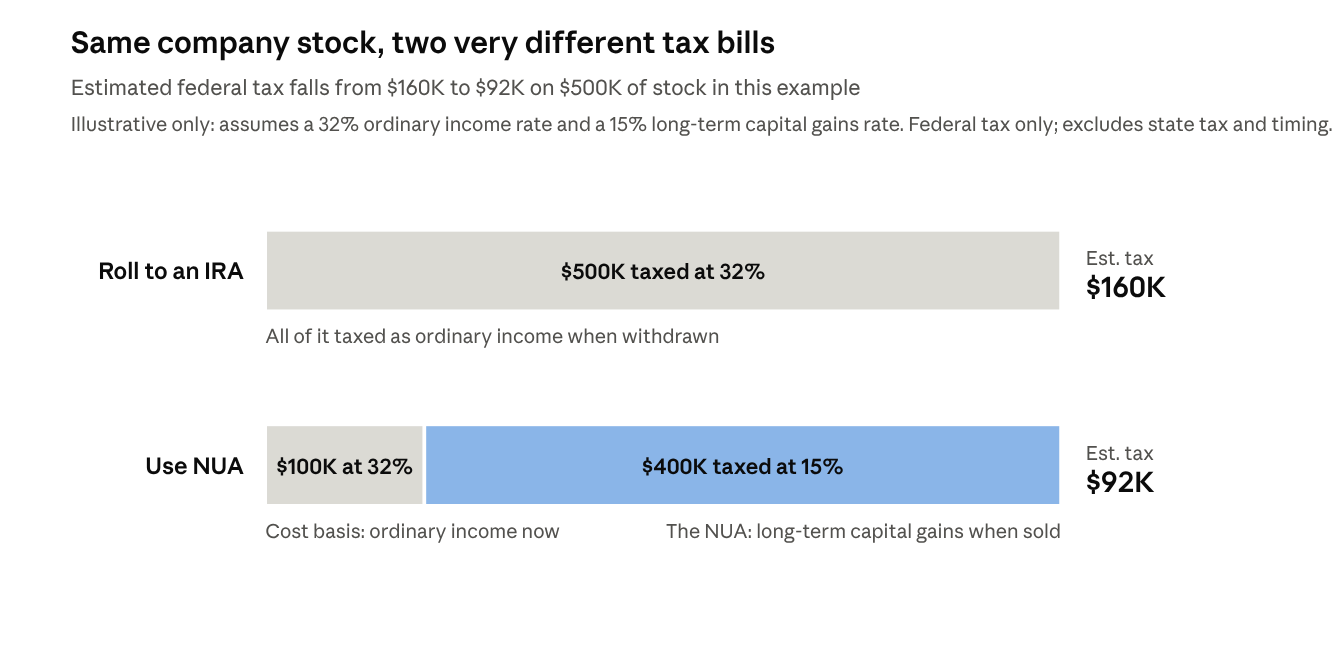
Illustrative example for discussion purposes; your numbers and tax rates will differ.
In this example, the stock is worth $500,000 and its cost basis is $100,000. Rolled to an IRA, the full $500,000 is eventually taxed as ordinary income. With NUA, only the $100,000 basis is taxed as ordinary income up front, and the remaining $400,000 is taxed at the lower capital gains rate when sold.
The Advantages
1) Lower tax rates on the growth. This is the heart of the strategy. Long-term capital gains rates top out well below the highest ordinary income rates, so converting years of growth from one to the other can save a significant amount, especially when the cost basis is small relative to the stock's value.
2) Long-term treatment, immediately. The NUA portion is taxed at long-term rates even if you sell the day after the shares land in your brokerage account. There's no waiting period to qualify.
3) You control the timing. The NUA isn't taxed until you sell. You can spread sales across several years, sell in lower-income years, or pair sales with losses elsewhere in your portfolio.
4) No required minimum distributions on those shares. Once the stock is in a taxable account, it's no longer subject to RMDs. Money left in an IRA eventually has to come out on the IRS's schedule; these shares don't.
5) You don't have to use it for every share. You can apply NUA treatment to some of your employer shares, typically the lots with the lowest cost basis if your plan tracks basis by lot, and roll the rest to an IRA along with the plan's other investments.
The Disadvantages
1) An immediate tax bill. The cost basis is taxed as ordinary income in the year of the distribution, whether or not you sell anything. Ideally, that tax is paid from other savings rather than by selling shares. If you're under 59½, a 10% early withdrawal penalty may also apply to the basis, depending on when you left your employer.
2) The math only works with a big gap. NUA shines when the cost basis is low and the stock has grown substantially. When the basis is a large share of the value, paying ordinary income tax on it up front can outweigh the capital gains savings, and you give up years of tax-deferred growth on that money.
3) Concentration risk doesn't go away. The strategy rewards holding company stock, and it's easy to let a tax break justify keeping too much of your net worth in one company. A large drop in the share price can erase the tax savings many times over.
4) The rules are unforgiving. The entire plan balance has to come out within one tax year, every plan of the same type at that employer counts, and the transfer can't be reversed. Taking an earlier partial distribution or rolling the account to an IRA first can disqualify you.
5) No step-up at death for the NUA. Most appreciated investments get a new cost basis when the owner passes away, wiping out the built-in gain for heirs. The NUA portion doesn't, so beneficiaries still owe capital gains tax on it when they sell.
6) State taxes and other details still apply. The savings shown above are federal only. State income tax, the effect of a large distribution on your bracket, and Medicare premium surcharges (IRMAA) all belong in the analysis.
Is NUA Right for You?
NUA tends to make the most sense when the company stock has grown well beyond its cost basis, you have cash outside the plan to cover the tax on the basis, and you're comfortable with a plan to reduce the position over time. It tends to make less sense when the basis is high, when you'd need to sell shares to pay the tax, or when you'd rather keep everything tax-deferred for many years.
Before you leave your employer, or before you move any money out of the plan, it's worth answering a few questions:
What is your cost basis? Your plan administrator can provide it, ideally broken out by lot, although some providers use average cost basis.
Have you had a triggering event, and is this the right tax year to use it? Leaving your employer, turning 59½, and other events each open the door. Timing the distribution for a lower-income year can help.
How will you pay the tax on the basis? Using cash from outside the plan preserves the most value.
How much of your net worth is in this one stock? Decide in advance how and when you'll diversify.
What's your estate plan for these shares? Because the NUA doesn't get a step-up, the tax picture for heirs is different.
This decision is hard to undo, so we recommend running the numbers before any money moves.
The Bottom Line
Net unrealized appreciation can turn years of growth in company stock from ordinary income into long-term capital gains, and for the right person the savings can be substantial. But it comes with an up-front tax bill, strict rules that leave no room for error, and the temptation to hold on to too much of one company.
If you hold appreciated company stock in your retirement plan, we'd be glad to walk through whether NUA makes sense for you before you make any moves.
DISCLOSURES:
The information provided is for educational and informational purposes only and does not constitute investment advice and it should not be relied on as such. It should not be considered a solicitation to buy or an offer to sell a security. It does not take into account any investor's particular investment objectives, strategies, tax status or investment horizon. You should consult your attorney or tax advisor.
The views expressed in this commentary are subject to change based on market and other conditions. These documents may contain certain statements that may be deemed forward looking statements. Please note that any such statements are not guarantees of any future performance and actual results or developments may differ materially from those projected. Any projections, market outlooks, or estimates are based upon certain assumptions and should not be construed as indicative of actual events that will occur.
This document is for your private and confidential use only and not intended for broad usage or dissemination.
No investment strategy or risk management technique can guarantee returns or eliminate risk in any market environment. All investments include a risk of loss that clients should be prepared to bear. The principal risks of CWA strategies are disclosed in the publicly available Form ADV Part 2A.
Past performance shown is not indicative of future results, which could differ substantially.
Consilio Wealth Advisors, LLC ("CWA") is a registered investment advisor. Advisory services are only offered to clients or prospective clients where CWA and its representatives are properly licensed or exempt from licensure.