
Target Date Funds: The Convenience and the Fine Print
If you've looked at the investment menu in your 401(k), you've almost certainly seen a lineup of funds with a year in the name: 2035, 2045, 2060, and so on. These are target date funds, and for many people they're the default 401(k) investment option they were enrolled in without ever making a choice.
The idea is simple. You pick the fund closest to the year you expect to retire, and the fund handles the rest. It holds a mix of stocks and bonds, and it gradually becomes more conservative as that year approaches. One fund, one decision, no rebalancing required.
That simplicity is a real strength. It also means you're handing a set of important decisions to someone who doesn't know anything about you other than your approximate retirement year. Let's walk through how these funds work, where they shine, and where they can fall short.
How a Target Date Fund Works
Every target date fund follows a glide path: a predetermined schedule for how its mix of stocks and bonds changes over time.
Early on, when retirement is decades away, the fund leans heavily on stocks for growth. As the target year approaches, it gradually shifts toward bonds and cash to reduce the size of the swings right when you're about to start drawing on the money.
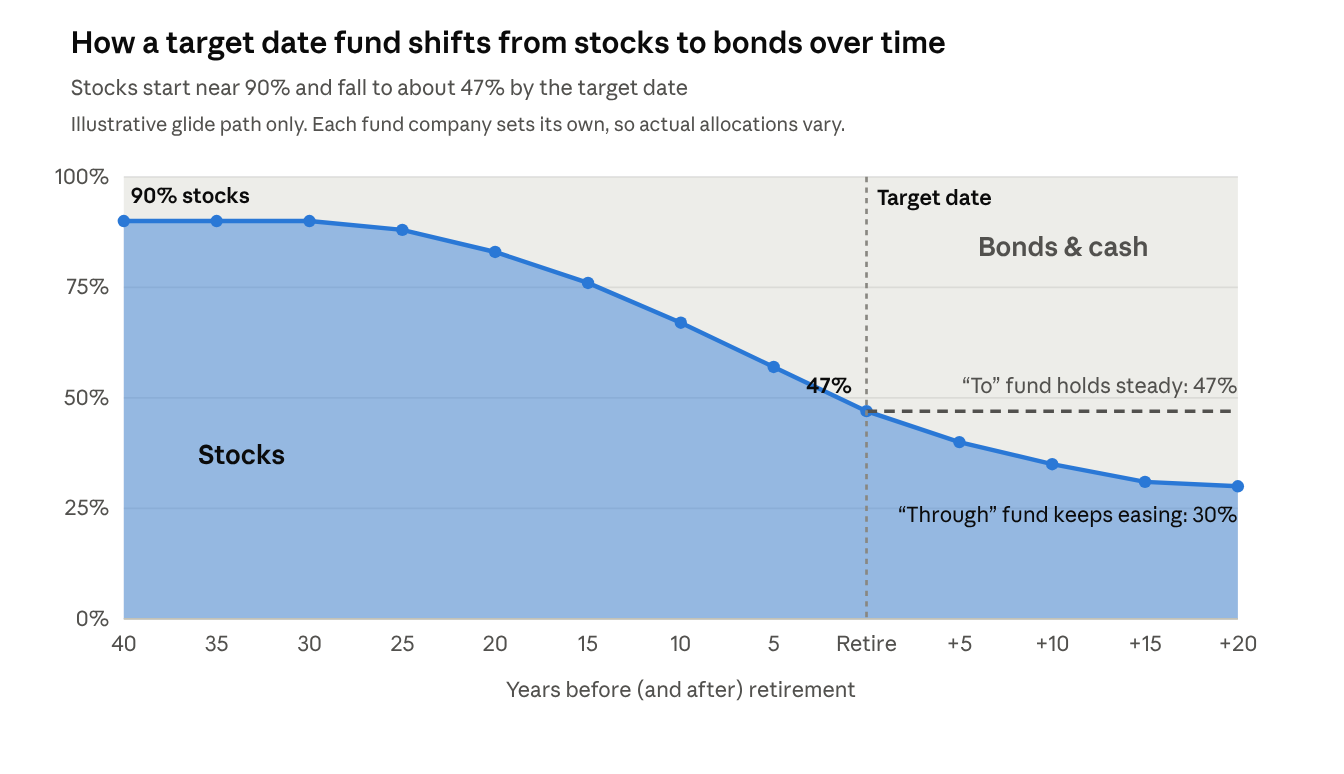
Illustrative glide path for discussion purposes; not based on any specific fund
The blue area is the share of the fund in stocks. Notice that the shift is slow at first and speeds up in the last 15 to 20 years. The two lines on the right show the difference between a "to" and a "through" glide path, which we'll come back to below.
The Advantages
1) Built-in diversification. A single target date fund typically holds U.S. stocks, international stocks, and several types of bonds. You get a broadly diversified portfolio without having to assemble it fund by fund.
2) Automatic rebalancing. Markets push a portfolio away from its intended mix over time. A target date fund rebalances for you, which quietly enforces the discipline of trimming what has run up and adding to what has lagged.
3) Risk that adjusts with your timeline. The shift from stocks toward bonds happens on its own. You don't have to remember to dial back risk as retirement gets closer.
4) Protection from ourselves. This one is underrated. Some of the most costly investing mistakes are behavioral: chasing last year's winner, or selling after a sharp decline. A one-fund approach removes a lot of the temptation to tinker.
5) A sensible starting point. For someone early in their career, or anyone without the time or interest to manage their own allocation, a low-cost target date fund is a far better outcome than leaving contributions in cash or spreading them evenly across whatever is on the menu.
The Disadvantages
1) One size fits all, by design. The fund knows your retirement year and nothing else. It doesn't know if you have a pension, a large brokerage account, a spouse with a very different timeline, or a stomach for volatility that's higher or lower than average. Two people retiring in 2045 can need very different portfolios.
2) Not all 2045 funds are the same. Each fund company designs its own glide path. At the target date, one provider's fund might hold roughly 30% in stocks while another holds closer to 55%. Part of that difference comes from whether the fund stops getting more conservative at the target date (a "to" glide path) or keeps shifting toward bonds for 10 to 30 years into retirement (a "through" glide path). Most target date funds today take the "through" approach. Either way, the year on the label tells you surprisingly little about how much risk you're actually taking.
3) Costs vary widely. Index-based target date funds can be very inexpensive, while actively managed versions often charge noticeably more. Because the fund is a wrapper around other funds, those costs can be less visible than they should be. Always check the expense ratio.
4) They don't play well with others. A target date fund is designed to be your whole portfolio. Pairing it with other funds, or holding target date funds in multiple accounts alongside individual investments, can undo the very diversification and risk control you bought it for. We often see clients who unintentionally hold two or three different allocation strategies at once.
5) Tax location is ignored. Because each fund holds both stocks and bonds, you can't place tax-inefficient assets in your IRA and tax-efficient ones in your taxable account. For that reason, target date funds generally make more sense inside retirement accounts than in a taxable brokerage account.
6) "Conservative" isn't the same as "safe." Even near the target date, these funds still hold a meaningful amount of stock. In 2008, some funds built for investors retiring in 2010 fell further than many of those investors expected. A target date fund lowers risk over time; it doesn't remove it.
Is a Target Date Fund Right for You?
Target date funds tend to fit best when your retirement account is your main pool of savings, your situation is fairly straightforward, and you'd rather not manage the allocation yourself. They tend to fit less well as your picture gets more complex: multiple accounts, equity compensation, a pension, significant taxable assets, or a retirement date that's uncertain.
If you own one, or are considering one, here are a few questions worth answering:
How much is in stocks today, and at the target date? Look past the year on the label to the actual allocation.
Is it a "to" or "through" glide path? This tells you how the fund will behave once you're retired.
What's the expense ratio? Compare it with the index-based options on your plan's menu.
What else do you own? If the target date fund sits alongside other funds, the combined mix may look nothing like what the fund intended.
Does the risk level match you, not just your age? If it feels too aggressive or too conservative, a fund with a different year, or a different approach altogether, may be a better fit.
The Bottom Line
Target date funds are one of the most useful tools to come out of the retirement plan world in the last few decades. They give investors a diversified, automatically managed portfolio with a single decision. The simplicity comes from generalization, however, and the more your situation differs from the "average" investor retiring in your year, the more that generalization can cost you.
If you'd like us to look at how your target date fund fits alongside the rest of your plan, we'd be glad to have that conversation. Reach out and let’s chat.
DISCLOSURES:
The information provided is for educational and informational purposes only and does not constitute investment advice and it should not be relied on as such. It should not be considered a solicitation to buy or an offer to sell a security. It does not take into account any investor's particular investment objectives, strategies, tax status or investment horizon. You should consult your attorney or tax advisor.
The views expressed in this commentary are subject to change based on market and other conditions. These documents may contain certain statements that may be deemed forward looking statements. Please note that any such statements are not guarantees of any future performance and actual results or developments may differ materially from those projected. Any projections, market outlooks, or estimates are based upon certain assumptions and should not be construed as indicative of actual events that will occur.
This document is for your private and confidential use only and not intended for broad usage or dissemination.
No investment strategy or risk management technique can guarantee returns or eliminate risk in any market environment. All investments include a risk of loss that clients should be prepared to bear. The principal risks of CWA strategies are disclosed in the publicly available Form ADV Part 2A.
Past performance shown is not indicative of future results, which could differ substantially.
Consilio Wealth Advisors, LLC ("CWA") is a registered investment advisor. Advisory services are only offered to clients or prospective clients where CWA and its representatives are properly licensed or exempt from licensure.